Keep on keepin' on...

Thursday, August 23, 2012
Win a FREE EDIT!
Keep on keepin' on...

 I help writers create compelling stories and build submission-ready manuscripts. If you're ready to run with your writing, join my free Facebook group, WRITERS WHO RUN (or Walk), and connect with hundreds of other writers with similar interests and goals. ~ bit.ly/writerswhorun ~
Wednesday, August 22, 2012
Lucky Clover Picture Book Contest: SPRING Winner Announced!
Romelle Broas
...for her lovely manuscript, Artsy-Fartsy Spider. It's a story about a spider who creates art with her spiderwebs and must find a way to deal with the jeers of her friends.
Congratulations, Romelle!!! You can expect your critique within 2 weeks.
The SUMMER Lucky Clover Picture Book Contest is NOW OPEN! For all the rules and details, follow these instructions. Hurry, the entry window closes September 30th.
Keep on keepin' on...
I help writers create compelling stories and build submission-ready manuscripts. If you're ready to run with your writing, join my free Facebook group, WRITERS WHO RUN (or Walk), and connect with hundreds of other writers with similar interests and goals. ~ bit.ly/writerswhorun ~
Friday, August 17, 2012
HIGH FIVE #19: Kindergarten Teacher Publishes Picture Book
Welcome to HIGH FIVE, the feature that spotlights debut picture book authors with a five-question interview. Today we have joining us, author/teacher Andy Allen. He self-published his first book, Stormin' Norman: The Soggy Doggy, and it was released in November 2011. As a Kindergarten teacher, Andy Allen knows just what kids like. Soggy doggies happen to be one of those things. Please join me in congratulating Andy on his recent success by giving him a big HIGH FIVE!

 Question FIVE: What are your top three writing tips you can offer to writers (and teachers) seeking publication?
| Stormin' Norman: The Soggy Doggy by Andy Allen |
So, here’s a big HIGH FIVE congratulations to you for your debut picture book.
Title: Stormin’ Norman: The Soggy Doggy
Author: Andy Allen
Illustrator: Brian Barber
Publisher: Beaver’s Pond Press
Release Date: November 2011
Summary: A story of friendship and the bond between a boy and his dog. The rhyme and illustrations in the book will entertain a wide audience, from young readers to teachers and parents. During the Iowa flood of 2008, many homes were destroyed and lives were changed forever. Stormin’ Norman: The Soggy Doggy provides a positive light on a difficult time for many people.
Question ONE: What are three of your favorite picture books? Just three mind you. Being a kindergarten teacher, I know this is going to be a tough one for you.
This is a difficult question. I read lots and lots of stories to my students. I try to have fun with the stories by using different voices and expressions to keep the students interested and entertained. I do have a few stories that I will read often throughout the year.
The first is The Giving Tree by Shel Silverstein. This book provides a wonderful example of friendship and self-sacrifice. It teaches us what love for a friend is all about and helps students understand better how we should treat our friends. The book can also lead to a discussion about the partnership that humans have with trees and we need to treat the trees kindly because they give us so much, from food to furniture to paper. It is also a good example of the life cycle of a person. I don’t think you can find a better story than The Giving Tree.
Another story I really enjoy reading is The Very Hungry Caterpillar by Eric Carle. This is another classic pick. The pictures in the book are so vivid and the kids enjoy watching the caterpillar getting bigger throughout the story. It helps young learners with their colors and numbers as well as a discussion about the life cycle and how we are like caterpillars. The caterpillar grows into a butterfly. We want our young learners to grow to be responsible young adults. This is a book that can bring a lot of discussion and learning into the classroom.
The last book is a book I just read but it has become one of my favorites. It is called I’m Not Tired Yet by Marianne Richmond. This is a story about a little boy who will not go to bed so his mom has to coax him into falling asleep by giving gorilla hugs and lobster pinches and such. The rhyming in this book is spot on and she really captures the silly spirit of the little boy. He kind of reminds me of myself when I was little. This is a well written, enjoyable book that is perfect for the classroom or home.
Gorilla hugs and lobster pinches? How fun!
Question TWO: Despite not having any children of your own, how do you feel that you were drawn to write for them?
My wife and I do not have kids, but we have two dogs and two cats, we feel we have enough excitement in our life at the moment. Even though I do not have kids, I have been in the field of early childhood education for about 10 years. I feel I have a good understanding of the cognitive process of a child and I can relate to kids well. My wife would tell you it is because I have the maturity of a 5-yr-old. When I am working on a story, I try to look at it through the eyes of a 5-yr-old and ask myself, why would I like this book? I feel that with the technology we have and the age of video games, books are becoming a smaller part in the life of a child so when writing and creating a story, it is important to make sure the child can identify and relate with the characters and themes within the story. I want to create stories that I would want to read to my students in my classroom.
I have heard that women mature faster than men. I bet your Kindergarteners adore you!
Question THREE: How might teachers use your book in the classroom? Did you write your book with teachers in mind? Do you have any lesson plans?
Over the month of June, I presented my book to 4 reading conferences in the state of Iowa. I talked with teachers about my book and how to use the book in the classroom. I have a curriculum written that covers, geography, science, and reading and writing skills. The curriculum also includes a game to help with fine and gross motor development as well as a list of a few other great dog books. Teachers can also use the book to discuss topics such as friendship, courage, pet responsibility and water safety. I wrote the book with teachers in mind, as a teacher if there is a book out there that I can apply to academic standards I will be more likely to use that book in the classroom. The students can enjoy a story and we can learn a few things as well, everybody wins!
Sounds awesome! A whole unit you wrote around your book? If I were teaching Kindergarten, I’d definitely be on board with your book. I can’t believe it covers all that. Amazing!
Question FOUR: What was your road to publication like? Can you talk a bit about revisions, submitting to publishers, and your experience with illustrators?
When I finished the story, I thought I had gold and I was going to be the next Dr. Suess, so I did some research and sent my story out to publishing houses that took material without having an agent and I got rejected. Then I got rejected. And finally, I got rejected.
There was one small publishing house that expressed some interest but they said it would be at least a year and a half to get the book out and I didn’t have any say with the illustrations. I was not a fan of that so I started looking at the self-publishing route. This story is very dear to me and I wanted to have input on the overall creation of the book. Self-publishing allowed me to keep some creative control and create a book that is of very high quality. I am very pleased with the book and my self-publishing experience. However, for my other stories, I would like to go through a traditional publisher.
The illustrator and I were able to meet and discuss the overall look of the story. I gave him a few pictures of Norm and told him I don’t want to stifle his creativity but it would be cool if he could make Norm look like Norm and he did a great job. We worked very well together. When he finished a page, he sent it to me and we talked about it. I generally had very few notes because he did such an amazing job. His pictures really tie the story together; he did a great job with the facial expressions of Norm and Andy throughout the story. And if I remember correctly, it was Brian that came up with the title. We were brainstorming for a title and he came up with that one. It was perfect.
I agree. Stormin’ Norman: The Soggy Doggy IS a great title! I’m so glad you had such a positive experience.
 Question FIVE: What are your top three writing tips you can offer to writers (and teachers) seeking publication?
 First, let’s remember that I am not a professional writer; I am a teacher who has begun to write books with the best interest of the child in mind. My next book talks about kids experiencing bullying on the playground, when Norm goes to the dog park and meets a bully.
So my first tip would be to write with the child in mind. Ask yourself, if I were five years old, would I like this book or can I relate to the book?
My second tip is to keep a notebook by your bed. I will get a great idea for a line in a story during the night and if I don’t write it down right then, I will forget it in the morning. So it is a good idea to keep something by your bed because you never know when your muse will bite.
And finally, this might sound cliché, but have fun. Children want to be entertained with literature, so have fun with the whole writing process. From your first draft to final version, the whole process should be enjoyable. There might be some stress, but as long as you enjoy writing, keep doing it. Don’t do it to become famous or wealthy. Do it because you feel like you have something to say and you enjoy telling stories. We need more great stories to entertain kids and compete with the video games. Books and reading help the cognitive development in young learners so it is so important that we keep the reading interesting for kids. I have met authors that do not encourage people to write stories because they do not want the competition. I feel just the opposite; we can never have too many good stories for kids.
Thank you so much, Andy, for being with us today. Congratulations again on your debut picture book! Hope your Kindergarten class starts out great and goes strong all year long. Good luck on your second book!
I help writers create compelling stories and build submission-ready manuscripts. If you're ready to run with your writing, join my free Facebook group, WRITERS WHO RUN (or Walk), and connect with hundreds of other writers with similar interests and goals. ~ bit.ly/writerswhorun ~
Wednesday, August 15, 2012
WriteOnCon
See ya later, and keep on keepin' on...
I help writers create compelling stories and build submission-ready manuscripts. If you're ready to run with your writing, join my free Facebook group, WRITERS WHO RUN (or Walk), and connect with hundreds of other writers with similar interests and goals. ~ bit.ly/writerswhorun ~
Monday, August 13, 2012
Story Element #8: Patterns
 Hello, world! I'm still here. I've been MIA for about 5 weeks. I've actually been WRITING. Dropbox is my new favorite thing, a free online service to help you back up and synchronize your files! It's awesome! It allows me to get more writing done without bothering with flash drives or e-mailing files to myself. I'd heard of it about a year ago; I don't know why it took me so long to actually give it a try. I LOVE it!!! Just be sure that when you hit SAVE, you wait for the file to finish syncing before you close the file.
Now that I'm finished working on my latest ms for a while, it's time to "catch up" on my blog.
Oh, blog, I love you so.I know, it's terrible rhyme and meter, and WORD PLAY was the last element I featured, but I couldn't resist.
Why oh why did I let you go?
My blog, my friend, I missed you so.
It's time to write some more and grow.
So, let's jump right in to Story Element #8, Patterns! Patterns in picture books often includes word play. Today's model certainly does. Other patterns in picture books include repetition, rules of 3, cycles, etc. The Very Hungry Caterpillar by Eric Carle has the pattern of going through the days of the week. Some books have the pattern of going through the day from morning to night, like Eric Carle's The Grouchy Ladybug. Repetition could mean a repeating refrain, like in Robert Munsch's Love You Forever: "I'll love you forever, I'll like you for always, As long as I'm living, My baby you'll be." Today's model is Big Chickens by Leslie Helakoski. We'll focus on repetition and rules of 3 (and rhyme).
Title: Big Chickens
Author: Leslie Helaskoski
Illustrator: Henry Cole
Publisher: Dutton
Year: 2006
Word Count: 697
Summary: While trying to escape from a wolf, four frightened chickens keep getting themselves into the very predicaments they are trying to avoid.
The repetition starts right from the very first page.
The chickens pwocked, flocked, and rocked. They knocked into themselves and each other until one by one they tumbled out of the coop.This page sets up the beginning of the repeated actions that happen throughout. It also has a lovely set of three rhyming words. Subsequent pages continue with one chicken saying, "I'm afraid to..." and the others follow with "Ohh...Me too, me three, and me four..." So the four ________, ___________, _______, _________ chickens walked on... In this case the adjectives are: cautious, careful, cowardly, chicken. Notice how lovely the alliteration is.
Another page:
The chickens tutted, putted, and flutted. They butted into themselves and each other, until one by one...And what do those four big chickens do?
Feet flew out from under, and bottoms flipped over. Bodies plucked up, and mud sucked down. Legs sank in. Necks stretched out. Until...Notice the wonderful use of assonance, the repetition of vowel sounds: "plucked, up, mud, sucked" and "legs, necks, stretched." The story goes from one predicament to the next. The pattern remains true. They have lively actions with rhyming verbs, then get scared, say "ohh my, me too," then continue on. It repeats 6 times. The language within the repetition is so much fun. I could read this book over and over and over. Oh, look another repetition in threes! An awesome example of threes from the book is...
The chickens picked, pecked, and pocked. They ruffled, puffled, and shuffled. They shrieked, squeaked, and freaked, until...Well, you'll just have to read the book to find out! The repetition is three verbs three times, and each set rhymes. The best part is that this book is part of a three-book series. Need help with writing pattern in picture books? Get your hands on Leslie Helakoski's Big Chickens, Big Chickens Fly the Coop (2008), and Big Chickens Go to Town (2010).
Do YOU have a favorite book that uses repetition? If so, please share below...
I help writers create compelling stories and build submission-ready manuscripts. If you're ready to run with your writing, join my free Facebook group, WRITERS WHO RUN (or Walk), and connect with hundreds of other writers with similar interests and goals. ~ bit.ly/writerswhorun ~
Wednesday, July 4, 2012
Story Element #7: Word Play
I'm so excited about today and not just because it's the Fourth of July.
Happy Fourth of July!!! I Love America!!!
Story Element #7 is word play, and word play makes reading and writing even more enjoyable. A great story will always be a great story. But good use of word play makes a great story a fabulous book! Word play helps add layers to the story - for children and parents. So what is this writing craft I call word play? It is the use of any number of literary devices such as metaphors, similes, puns, vivid verbs, synonyms, alliteration, assonance, consonance, vocabulary, and more. Need definitions? See below...
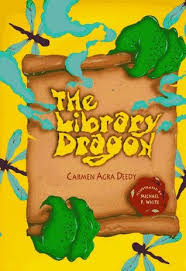 Today's example is The Library Dragon by Carmen Agra Deedy and illustrated by Michael P. White. This is probably my favorite picture book of all. I first read it to my children when I checked it out from the library a few years ago. We've gotten it several times since. We all love it!
Happy Fourth of July!!! I Love America!!!
Story Element #7 is word play, and word play makes reading and writing even more enjoyable. A great story will always be a great story. But good use of word play makes a great story a fabulous book! Word play helps add layers to the story - for children and parents. So what is this writing craft I call word play? It is the use of any number of literary devices such as metaphors, similes, puns, vivid verbs, synonyms, alliteration, assonance, consonance, vocabulary, and more. Need definitions? See below...
- simile - a comparison using like or as, often used in tall tales (She was as tall as an old Oak tree.)
- pun - a play on words, often like a joke, using a word that has more than one meaning (He was getting tired of running down the street and smelling car fumes. He said, "I'm exhausted!")
- vivid verbs - verbs that stand out and aren't boring or overused (Instead of saying: She walked to the store, say: She trudged to the store, or She ran to the store.)
- synonyms - a word meaning the same as another word, like ran, dashed, raced, etc. I group similar related words in this category too. (In a book about astronauts, you might use the following words: moon, shoot for the stars, the planets aligned, dazzling, sparkling, gleamed like a diamond, blue moon, translucent, waxing, venus, zoom, lunar, space, launch, the void in my head, speeding, etc.) RhymeZone is great for this!
- alliteration - the repetition of same sounds at the start of a
sentencewords: s, s, s, s (Lucky Lucy loves to lick lilac envelopes.) - assonance - repeated vowel sounds in the middle of words such as vOWel and sOUnds (He dreamed each evening of weeks on the beach.)
- consonance - repetition of consonant sounds, not necessarily at the beginning of words (Sally loved to fly in airplanes because she liked how the wind flew through her hair and helped her feel like she was floating.) I know that's not a great sentence, but there are 10 instances of the letter "L".
- vocabulary - words that stretch a person's knowledge of language (like hoist, gleam, and fragment among thousands more)
Title: The Library Dragon
Author: Carmen Agra Deedy
Illustrator: Michael P. White
Publisher: Peachtree Publishers
Year: 1994
Word Count: 983
This book is FILLED with LOTS of word play. Here we go...
From the newspaper ad before the book begins:
- "seeks a thick-skinned professional" (pun)
- "a burning love of children" (pun)
- "must be on fire with enthusiasm" (pun)
- "no half-baked applicants need apply" (related words)
- "call 555-S.E.A.R. (Sunrise Elementary Adores Reading)" (related words)
And here's one from the first page:
- "The new librarian, Miss Lotta Scales, was a real dragon." (puns)
And the fun just keeps getting better (each bullet point is an actual quote):
- library lair (related words aka 'related')
- kept a fiery eye out (related)
- made her hot under the collar (related)
- an unfounded fear of dragons was positively inflammatory (pun)
- pencil and claw sharpener (illustration)
- got so fired up about this, she incinerated (vocabulary)
- Caliente Jellypeno Beans (illustration)
- "Where there's smoke, there's fire, and that Miss Scales is a real dragon, all right." (related)
- PTA MEETING Topic: "Dragons Throughout History: The Myth, the Mystery" Speaker: Sir Whyte Knight (illustration)
- they kept coming back singed (related)
- If alarmed, pull tail (illustration)
- Attention non-dragons NO smoking in the library (illustration)
- his plan backfired (related)
- Principal Lance Shields (illustration)
- Instead of cooling her down, he just fanned the flames. (related)
- "Oh really? And who does the firing?" asked Miss Scales with a glare and a flare that caught his tie on fire." (Okay, I'm not going to label these anymore, just enjoy!)
- waved the smoke out of his face
- "No smoking in the Library," Miss Lotta Scales said drily.
- The principal fumed. The teachers were incensed.
- their grades were going up in smoke
- a trip to the cafeteria kitchen to fortify themselves
- she smouldered (verb)
- "shmorie-time," blew Miss Lotta Scales
- threw down their weapons and clanged out
- "Good Knight, Miss Lemon, you slay me," cracked Miss Scales. "Why the idea of storytime is simply medieval."
- is a real spitfire
- spewed so much smoke and fire
- She was really draggin'
- she was burned out
- closed her scaly lids
- Brickmeyer
- on a quest
- spread like wildfire
- Sunrise
- her ears were burning
- roared (verb)
- scaly blur
- cleared the smoke from her throat
- scorched
- warm
- crackled
- clickety-clack
- little bit of a dragon
- the end of our tale (pun, illustration)
See what I mean? You can't read this book and not love it, I tell you. It will simply set your heart on fire!
If you missed previous posts from this Story Elements series, click below to read more.
Story Elements #1: Character
Story Elements #2: Conflict
Story Elements #3: Plot
Story Elements #4: Dialogue
Story Elements #5: Theme
Story Elements #6: Pacing
Next week: Story Elements #8: Patterns
What are some of your favorite books that use lots of word play? I may use some of them in future word play posts.
Keep on keepin' on...
I help writers create compelling stories and build submission-ready manuscripts. If you're ready to run with your writing, join my free Facebook group, WRITERS WHO RUN (or Walk), and connect with hundreds of other writers with similar interests and goals. ~ bit.ly/writerswhorun ~
Monday, July 2, 2012
HIGH FIVE #18: Bethanie Murguia Gets Ready to Publish Again
Welcome to HIGH FIVE, the feature that spotlights debut picture book authors with a five-question interview. Today we have joining us, author/illustrator, Bethanie Murguia. Her first book, Buglette the Messy Sleeper, was released in May 2011 by Tricycle Press. Shortly thereafter, I discovered Bethanie and her Buglette book. My schedule is semi pre-booked a year in advance and during that time, she had her second book in the works. Zoe Gets Ready was just released a couple of months ago. Please join me in congratulating Bethanie on her recent success by giving her a big HIGH FIVE!
| Bethanie's second book! |
Title: Zoe Gets Ready
Author: Bethanie Murguia
Illustrator: Bethanie Murguia
Publisher: Arthur A. Levine Books/Scholastic
Release date: May 2012
Word count: Approximately 180
Short summary: Each day is full of possibilities, and Zoe wants to be ready for everything this day might bring. But that makes getting dressed really, really hard! As the clothes pile up and Mama tells her it’s time to go, there’s only one way Zoe can be sure she’s prepared for all of the adventures ahead.
I’ve read your book and it is so much fun. Anyone who has a daughter will definitely be able to connect! Your summary is spot on, and has such a lovely ending! Beautiful illustrations too!
Question ONE: What are some of your favorite picture books? Two for stories and two for illustrations.
These choices are all for story AND illustration—is that cheating? It’s hard for me to separate the two.
Knuffle Bunny by Mo Willems
Olivia by Ian Falconer
The Christmas Magic by Lauren Thompson/Jon J Muth
Me…Jane by Patrick McDonnell
Question TWO: What is your bedtime routine like; how do books play a part in that?
Books have always played a part in our bedtime routine. My daughters are three and six now. For a long time, we read picture books every night before bed. Now, we read both chapter books and picture books. Then my six-year-old climbs into her top bunk, turns on her reading light, and reads long into the night.
Picture books are often part of our take-a-breath routine too. When I find that my daughters are unruly and/or over stimulated, sitting down and reading to them for five or ten minutes is almost always the best way to get everyone back on track.
I think I’ll have to try the take-a-breath routine. My children are five and eight. We recently added reading a chapter book along with our picture books at night.

Question THREE: How might teachers use your book in the classroom? Do you have any lesson plans available?
There are discussion guides for both Zoe Gets Ready and Buglette on my website (aquapup.com/activities.html). These guides include a variety of creative projects and downloads for classrooms. Zoe Gets Ready, with its emphasis on individuality and imagination, is a great jumping off point for open-ended projects that encourage children to come up with their own creations. It also lends itself well to discussions about clothing (for example, how clothing differs across cultures). In addition to an emphasis on individuality, Buglette, with its ladybug and crow characters, can be used as a starting point for science discussions about real ladybugs and crows—both very interesting creatures!
Sounds perfect for Kindergarten through 3rd grades!
Question(s) FOUR: How many books had you illustrated before you published YOUR story? How was being the author/illustrator different from being the illustrator only? Do you see yourself as mainly an illustrator or more as an author? Do you have an agent? If so, how did that happen? Does he or she represent your illustrating, writing, or both?
I have illustrated stories (that were not my own) for magazines, but I was the author and illustrator of my first picture book. I like telling stories with words and pictures, so it feels very natural to sit down and work back and forth between the two. I went to art school for illustration and then worked as an art director for many years. So my background is definitely more on the illustration/visual side of things. At this point, I suppose I think of myself as a storyteller.
I do have an agent; she represents me as a writer and illustrator. We found each other when I was submitting the dummy that eventually became my first published book (Buglette, the Messy Sleeper). It is a great partnership.
 Question FIVE: As an illustrator, what are some writing tips you can offer to writers seeking publication? What types of things should writers try to consider from an illustrator’s perspective?
I think the best picture book manuscripts leave plenty of room for interpretation and for the illustrator to bring his or her unique life experience to the story. If the manuscript is too prescriptive, it doesn’t give the illustrator as much space to play and get inspired!
Thank you for being with us today. Remember to come back next month on Monday, August 6th to meet another debut author. And check out the other debut authors if you haven't done so already.
I help writers create compelling stories and build submission-ready manuscripts. If you're ready to run with your writing, join my free Facebook group, WRITERS WHO RUN (or Walk), and connect with hundreds of other writers with similar interests and goals. ~ bit.ly/writerswhorun ~
Friday, June 29, 2012
Eat That Frog: Why We Wait for What We Want
 Say WHAT?! Eat that frog? What's up with that? Well, I'll tell you. But first, today's post is about a celebration (or lamentation) of Julie Hedlund's 12x12 Challenge. If you've never heard of it, it's a picture book writing challenge. Write 12 picture book manuscripts in 12 months. Rough drafts, not polished. Totally doable. A lofty goal? Yes, but totally doable.
 My progress? I did not make the cut of getting 6 mss; I wrote 2. TWO! That's it. I am happy with them as a ms. I am happy that I got them written. It is still progress, though it doesn't feel like much.
| Watch a video. |
Why do we tend to put things off that we really want to do? The book doesn't specifically go into answers for this question I am posing, so I am kind of speculating as to the answer. (If anyone else has any answers for the question, I'd love to hear them below.) I believe the main reason is FEAR. And not necessarily fear of failure either. Or fear of success. I think we put things off that we want to do because we fear it will take too long or be too difficult. Or fear of your own passion because once you get started, you may not be able to tear yourself away to tend to the daily necessities of life.
If you didn't get your 6 mss in the past 6 months, which fear reason do you think is yours to own? Or is it some other reason?
- not enough time (too busy)
- choosing to spend time on another passion
- lack of commitment
- fear of failure
- fear of success
- fear of the challenge (too difficult)
- fear of time constraints (not being able to complete the task at hand within your daily time parameters)
- fear of your own passion
Mine is 2, 6, 7, and 8. What about you? CONGRATS TO ALL OF YOU WHO MADE THE 6 IN 6!
Keep on keepin' on...
I help writers create compelling stories and build submission-ready manuscripts. If you're ready to run with your writing, join my free Facebook group, WRITERS WHO RUN (or Walk), and connect with hundreds of other writers with similar interests and goals. ~ bit.ly/writerswhorun ~
Subscribe to:
Posts (Atom)
Link Within
