Monday, October 31, 2022

Dealing with Writing and Running Distractions

It’s Halloween morning as I sit here writing this. And there’s nothing scarier than letting your plans get derailed from a distraction, no matter how big or small. After I graduated from college, I stopped writing. Life included things like finding a job, having two children, and even going back to school to get my elementary education degree. Back then, it seems like all I was writing was lesson plans. I’ve had the dream ever since I was a little girl to become a published author with lots of books on bookstore and library shelves. But life distracted me. The scariest thing for a writer with big dreams is to never reach their goals. And if I wasn’t writing anything, that would happen to me too. So how do you get rid of distractions or deal with them when they show up?

  1. Schedule time for your goals
  2. Set priorities to protect what’s important
  3. Get away for a weekend to help you focus


Schedule Time For Your Goals


I’ve heard people say, “If it’s not on the calendar, it doesn’t get done.” I have found that to be true. Of course, just because I don’t have my calendar filled with things to do doesn’t mean I’m sitting around like a bump on a log doing absolutely nothing. It just means that I’m letting daily distractions get in the way of doing anything meaningful that would help me reach my goals.


Like run a 50k or write my middle grade fantasy series.


One thing you can do is get a planner. On the calendar, schedule a time block to sit down and write. It doesn’t have to be 2 or 3 hours every single day. It can be as little as 20 minutes just two to three days a week. Schedule your exercise time. Put it on the calendar. It will help you be more consistent and every time you look at your calendar, you’ll have something to look forward to and start getting excited about it.


What about big distractions that you know about ahead of time? Like holidays (hello, Halloween), weddings, family reunions, or graduations? Schedule your writing and running time around those dates. Either take a few days off or schedule it for a different time.


Set Priorities


Setting priorities means putting what’s most important to you at the top of your list. People who like to run in the mornings guard their workout routine (and their time) because running is a priority for them. If you don’t do it first thing in the morning, it won’t get done. Others may like going to the gym right after work because that feels more convenient – and it’s on their calendar, so it’s a priority.


If there’s something you want to do, you have to make it a priority, or else you’ll let distractions take over. Want to attend a writing retreat next summer, then schedule it! Otherwise, you’re saying to yourself, “Well, if nothing else better comes along, THEN I’ll go on the retreat.” That line of thinking is evidence that the retreat is not a priority for you. Priorities come first, no matter what else comes along. Granted, other things do come along like sickness or death. In those cases, your health or dealing with grief becomes your new priority.


So protect your writing and running schedule by actually putting your time on the calendar. That way other things can’t creep in and take over that time. That goes for daily rituals, weekly priorities, and yes, also annual events, like the Writers Who Run Retreat.


Get Away for a Weekend


Another way to deal with distractions is to create a mini-getaway for a couple days. A two or three day weekend can do wonders for blocking out daily distractions and creating the space to focus on your goals. You can go to a local B&B, or the Motel 6 just down the street. One or two nights is all it takes to get away from the family, the dogs, and the phone so you can focus on your goals. 


A weekend getaway is a welcome distraction from the daily grind of cooking meals, doing laundry, and other chores. If you’re lucky, your spouse and children will pitch in and help out while you’re gone. If not, it’ll be there when you get back. More often than not, most writers seem to prioritize writing over cleaning house anyway. So you’re definitely not alone there.


What to do on your weekend getaway? Work on your most pressing project, even if you don’t have any hard, fast deadlines. Set a mini goal for yourself, such as finishing the next four chapters or running through your second-pass revision. While you're at it, set a goal to run too. Prepping for a race? Be sure to map out a route ahead of time, or make sure the hotel has a gym with a treadmill.


To sum it all up, the best way to deal with distractions is to prioritize what’s most important, set aside time on the calendar to focus on it, and possibly take a weekend to yourself a few times a year to make a little momentum toward your bigger goals.


Keep writing, keep running.


XO, 

Christie :)


What’s one of your priorities? Share in the comments.


Keep on keepin' on...

BACK TO TOP | READ MORE POSTS

Monday, October 24, 2022

Becoming a More Consistent Writer and Runner

It’s no fun when you’re in a writing rut or a running slump. Inaction. What? No writing or running?! Yes, it happens to the best of us. Sometimes life gets in the way and we take a much longer break than anticipated.

Maybe it’s spring and your allergies have kicked in - no running. Maybe it’s summer and it’s too hot. Or your autumn allergies are in full swing combined with being too chilly for an early-morning run. Maybe it’s winter and it’s just downright too cold no matter how many layers you dress in. Or maybe all of these things are simply excuses for a reason to not go out and run. Some people join a gym and use a treadmill. Others don’t care what the elements are doing, they’ll run outside no matter what. 

Writing ruts are no different. Writer’s block, deadlines, procrastination, being consistent, you just finished a big project… no matter what the reason is, it’s still just an excuse. 

Rather than beat yourself up over it and continue to stay stuck, stalled, or stagnant, try getting more consistent with a writing or running schedule to break out of the cycle of inaction.


Set a Goal

The number one way to get out of a rut and get more consistent with your writing or running is to set a new goal. Sometimes getting excited about a new goal is all it takes to get back in the saddle again. Perhaps you’re participating in NaNoWriMo (National Novel Writing Month) or you’ve just signed up to run your next 10k race. Either way, having a goal gives you something to work toward and gives you a new opportunity to create a little momentum.


When thinking about your goals and trying to be consistent toward reaching them, think about these seven tips.


  1. Follow Your Dreams
    Be sure you’re following your own dreams and not someone else’s. If you’re not following your own dreams, then ask yourself whose dreams are you following? Parents, society, teachers, friends? When you follow your own dreams, you truly care about the results and that will help you be more consistent.

  2. Break Your Goals Into Bite-size Chunks
    When your goals are large, it’s easier to think about reaching them when you break them down into smaller tasks. This also helps create consistency.

  3. Get Organized
    Getting organized gives you clarity about your priorities and helps you manage your time better. So clean off your desk and see a boost in your consistency with your writing.

  4. Know Your Why
    Writing down your goals and posting them where you can see them every day is a great way to keep them front and center. But take it another step further. Write down WHY your goals are so important to you. WHY do you care about this goal or your bigger dreams? Knowing your why will make you more conscious about taking action so you don’t procrastinate. Action creates clarity and consistency.

  5. Connect with a Fellow Writer or Runner
    Talking with a trusted friend who understands or even shares some of the same goals as yours can help you when you struggle with negative emotions. Brainstorming, listening, and sharing with each other bolsters consistency, accountability, and momentum.

  6. Take Time to Do Things You Love
    Things you like doing keep your creativity alive, which is important for writers. Finding time to do things aside from working toward your goals increases creativity, efficiency, consistency, and productivity. It could be knitting, painting, collecting something, baking, or playing a musical instrument.

  7. Visualize Your Results The more often you visualize your dreams and the journey to get there, the more dedicated you’ll be toward it. You’ll be more excited to continue taking consistent action. So keep the bigger picture in mind and enjoy your results!


Give Yourself a Challenge

There are two types of goals: achievement goals and habit goals. Setting a new goal typically makes people think of an achievement goal such as writing 50,000 words toward your novel in a month, or participating in a fun 10k race. But habit goals are what can create real consistency around your writing and running dreams.


One way to create and track a habit goal is to write down the action you want to accomplish on a daily, weekly, or monthly basis and put a check mark on a calendar every time you take action. Another thing you can do is to issue yourself a fun new challenge. What’s something you can do for 5, 10, or even 30 days in a row? Write for 10 minutes a day? Write a poem a day? Run a mile? Stretch for 10 minutes?


I created a social media livestream challenge. To show up live and share things about writing and running for 45 days in a row. So far, I’ve done 3 videos, which is more than I’ve done in the past 6 months. So I’d say my challenge has been successful so far in helping me take action.


Celebrate Your Wins

Sometimes it’s hard to have a winner mindset when you feel like you can never gain any traction with your goals of being a more consistent writer and runner. You want to write five times a week, but you only manage one day. You want to run four times a week, but you only manage one day. Yikes! What’s a writer and runner to do?


If you follow the tips above, you’ll be well on your way to creating more consistency when it comes to reaching your goals, whether they be an achievement goal or a habit goal. Another way to create more consistency with your writing and running is to attend the annual Writers Who Run Retreat where you’ll be running every morning for 5 days in a row and you’ll be writing, revising, and learning more about craft for 5 days as well. Attending the retreat creates massive momentum!


The final tip is to celebrate your wins! Keep taking action even in the face of failures or setbacks. Focus on your efforts rather than the results. And celebrate EVERY WIN, no matter how small. You wanted to run 3 miles today, but you only walked 1 mile? Great! You got out there and did. Habit streak kept intact. WIN! You wanted to finish the next chapter in your book, but you only got 2 pages written? Great! You still wrote and maintained consistent action. WIN!


Not only should you celebrate all your wins, no matter how big or small, but it also helps to celebrate the wins of other people. See that someone just finished their first 5k in 45 minutes? Give them a high five! Someone published a poem in a local magazine? High five! Following others and seeing their successes will motivate you to keep going - especially when you celebrate their wins with them.


Keep writing, keep running.


XO, 

Christie :)


Which passion do you most want to get consistent with? Your writing or your running? Click here to share a comment.


Keep on keepin' on...

BACK TO TOP | READ MORE POSTS

Thursday, July 28, 2022

Three Book Recommendations to Help You Tackle Revisions

I have a picture book manuscript that I have revised 17 times. Ultimately, my agent couldn’t sell it, even though she tried for a solid year. It was a biography about a white male from Scotland in the 1800s about a very popular toy he accidentally invented. Apparently, the world didn’t want any more male biography picture books at that time.

While revising a picture book is no small feat, revising a novel always felt like an even bigger feat. Most of my revisions were inspired by my amazing critique group and the feedback they offered me month after month. Other revisions came after carefully processing the information from multiple writing workshops, conferences, and retreats I attended.

Today, I share with you three books about editing and revision that have helped thousands of writers move forward in the writing process. Because your story deserves more than just a proofread and a polish. You’ve got to strengthen your story to make it the best that it can possibly be. And that only comes from revising it.


Intuitive Editing by Tiffany Yates Martin


It’s hard to look at your own writing objectively. If your goal is to create a tight, polished, publishable story—self-editing is a skill you need to learn. Intuitie Editing: A Creative and Practical Guide to Revising Your Writing was published in 2020. With 280 5-star reviews on Amazon and 5 fabulous testimonials on the blurb section, you can’t go wrong with this pick!

Intuitive Editing will lead you to deepen and elevate your own work, while developing your editing skills. Martin teaches you how to solicit and process feedback. She helps you discover what works for your story and your style—to find the best version of your own book vision, whether you’re writing fiction, narrative nonfiction, or memoir. This book will give you the tools you need to approach editing and revising your own writing filled with inspiration, motivation, and confidence.

The book is divided into four different parts. Every chapter is filled with lots of examples and includes two main sections: How to Find It, and How to Fix It. Probably the best part about the book is her extensive list of probing questions to help you think more deeply about your book. The very same types of questions she asks her clients.
 

Troubleshooting Your Novel by Steven James


Steven James is an award-winning author. This book, Troubleshooting Your Novel, was published in 2016 and won the 2018 Storytelling World Award. This book was written to help you revise your novel after you have completed the first draft. The subtitle reads: Essential Techniques for Identifying and Solving Manuscript Problems. And EVERY manuscript has problems in the first draft.

This book spends a great deal of time focusing on plot and character, as well as other story elements such as dialogue, suspense, voice, subtext, and flow. James helps you fulfill reader expectations and become a writer that readers can trust. He helps you check your manuscript for problems with context and continuity.

The book is broken down into 5 parts and includes a total of 80 chapters.

  • Part I: Story Progression 
  • Part II: Characterization 
  • Part III: Narrative Techniques 
  • Part IV: Reader Engagement 
  • Part V: Style and Finesse

Each short 3-4 page chapter includes an overview, how to fix the issues of that particular element, a question with a quick fix, and a list of tips to fine-tune your manuscript. Chapter 50 includes a great chart of 9 dialogue problems and how to fix them. This is a great book published by Writer’s Digest Books. I highly recommend it!


The Last Draft: A Novelist’s Guide to Revision by Sandra Scofield


According to the Amazon description, The Last Draft: A Novelist’s Guide to Revision by Sandra Scofield is the “definitive handbook for the novelist who is ready to revise.” That’s all of us, right? Once you get your first draft written, get this book to help you turn your manuscript into the novel of your dreams.

Sandra Scofield is an award-winning novelist, a longtime teacher, and a critic. She shows you how to reread a work of fiction with a new view of the subject and vision in mind. You’ll learn how to take things apart and put them back together stronger and deeper.

The book, published in 2017 published by Penguin Random House, includes an overview of “the novel” and explains helpful literary concepts like narrative structure, character agency, and core scenes, using plenty of examples from both classic and contemporary writers.

Scofield outlines her stages of revision and goes deep into each.

  1. A Close Look 
    • Description Assessment 
  2. The Plan 
    • Summaries 
    • Core Scenes 
    • Lines of Threads 
  3. The Process 
  4. The Polish

Lastly, the book includes some wonderful additional resources including Recommended Books on Craft, Lessons from Model Novels, Sample Scenarios, Storyboarding, and a Scene Template. The Last Draft is for both beginning and advanced writers. It provides a detailed, step-by-step plan with invaluable advice to guide you through the emotional and intellectual journey of being a novelist.

QUESTION:


What’s the most number of times you’ve revised a single manuscript? Share in the comments!


What are some of your own writing and running accomplishments? Click here to share a comment.


Keep on keepin' on...

BACK TO TOP | READ MORE POSTS

Thursday, June 30, 2022

Five Steps to a Healthy Writer Mindset

A positive mindset is a must for writers if you want to be successful. Of course, success can be as simple as finishing the first draft of a manuscript or as big as becoming a #1 bestselling author on the New York Times list.

One thing’s for sure, though. If you give up and quit moving forward, you’ll never reach your writing goals. That’s why it’s so important to develop a healthy mindset. So you don’t give up. A healthy writer mindset keeps you going.


Nix the Negative Self-talk


I know how hard it can be to fall prey to negative self-talk. When I graduated from college, I got a B on my senior thesis (a novel). Don’t get me wrong; I was happy with the B. But my professor scribbled something underneath my grade.

“This still to me seems to not be of professional quality.

Because of that comment, I ended up not writing creatively for 10 years! I know, it seems kind of petty. But to be fair, it was more of a subconscious thing. Still, the negative self-talk was not good. I believed things like: 
  • I’m not good enough to be a writer. 
  • I’ll probably never get published.
  • I just wasted four years of college on a Creative Writing degree I’ll never use. 
  • Writing is too hard; I’ll just stick to journal writing
  • Nobody cares about the stories in my head; it’s useless.

But one day, somebody did care. They saw that I had expertise in writing, editing, and storytelling. They wanted my feedback. And I got excited about my writing again. I haven’t looked back since. It just takes one single moment to nix the negativity and get back to your writing. You’re worth it. Go for it!

Five Steps to Create a Healthy Mindset


A positive mindset is powerful. The day I heard about (and watched) Rhonda Byrne’s The Secret was the day I was introduced to the law of attraction and to manifesting your life’s dreams. Not to get all woo-woo on you, but that concept was huge for me! I can’t believe I’d never heard of the Law of Attraction. Really?! Anyway, one of the biggest takeaways from that was confirmation for how powerful the mind truly is. Here are 5 ways to keep your mind positive so you can live the life of your writing dreams.

1. Identify your fears. 

It’s a lot easier to overcome your fears and be positive about it when you know what they are. Your fears are often synonymous with your negative self-talk. My fear was that I wasn’t good enough. That nobody cared. That I didn’t have what it takes to be a writer. But now I know better. 

I AM good enough to pursue my writing dreams. Lots of people care about what I have to offer, whether that be the stories in my head or my ability to help others bring their stories to light. And while my books still haven’t been traditionally published yet, I do have two indie pubs and I’m working on a third. 

2. Focus on the good things. 

You know that fuzzy blurry look when something’s out of focus? That’s what happens to your brain when you’re working toward a goal but you’re not focusing the right things. The right things to focus on are the good things. Put your blinders on to negativity. 

Good things might include progress you’ve made, baby steps you’ve taken, awards you’ve won. Even a rejection letter can be seen as a good thing - it’s just one more ‘no’ to receiving your ‘yes’. It only takes one ‘yes’ for a book deal. Whatever your good things are, focus on them. 

3. Practice gratitude. 

Gratitude is huge! When you’re truly grateful for what you have right now, you will be blessed with more things to be thankful for. I’m grateful for self-acceptance. I’m grateful for all the progress I’ve made in my writing career thus far. I’m grateful that you are reading this right now. I’m grateful for my awards and accomplishments. I’m grateful for my agent. I’m grateful for my writing notebooks, for my ideas, and for the books I’m working on right now. What are you thankful for? 

4. Experience humor. 

Laughter is the best medicine. I’ve read true stories of people who have healed themselves from debilitating diseases, cancer, and horrible hospitalizations from humor. They watched funny movies every single day. They found happy things to focus on and tried to laugh as much as possible. Humor lightens the mood. And that includes a negative attitude. Try to welcome more humor and laughter into life. It will help you create a more positive writer mindset. 

5. Live in the moment. 

Living in the moment is a great way to stay grounded. When negativity starts to creep in, be thankful for where you are right now. Experience the joy in the current moment. If bad things are happening, be thankful for the air you breathe. You can take a deep breath and focus on something good. That you can walk. That your home is comfortable. That you have a job (even if you hate it) because that means you can pay your bills. A friend. A hug. A shoulder to cry on. 

Start with one thing and enjoy it. The sun shining on your face. Anything. Don’t think about the past and your failures. Don’t think about the future and your fears. Think about the current moment and be grateful for it. Focus on the things that bring you joy. The special pen you write with. The beautiful journal you write in. Your online writing friends. Give it a try and see how living in the moment can help you create a better author mindset.


Start a Gratitude Journal


When you write for yourself first, you enjoy the process more. And that will definitely keep you going. Another thing I’ve started doing is to keep a gratitude journal. I use it for everything, not just my writing. It absolutely helps keep my mind positive. It re-energizes my excitement for life. My favorite way to do this is to use the left page for gratitude for your current life. And the right side is for gratitude intentions - your future life written in such a way that it’s already happened. Not just the fact that it has happened, but how it makes you feel and what you’re now able to do as a result of achieving the thing you’re trying to manifest. Give it a try and let me know how it goes!

In conclusion, when you’re having a down and out day and you feel the weight of the world on your shoulders, or even if you simply stub your toe, implement these positive mindset hacks to help you lighten your load (and your mood). If you notice negativity creeping in, acknowledge it and then take steps to create a more positive outlook for your writing life. A healthy mindset will help you go the distance and reach your writing goals as an author. 

QUESTION: 
I love using my gratitude journal. Do you have one? Let me know in the comments!


What are some of your own writing and running accomplishments? Click here to share a comment.


Keep on keepin' on...

BACK TO TOP | READ MORE POSTS

Tuesday, May 31, 2022

Top Tips for Writers to Continue Learning the Craft

Being a writer is all about continued learning. Even when you become a published author, you still need to keep learning and develop your writing craft. Doctors go to seminars. Teachers attend in-service workshops. Mechanics, managers, and other professions take continued education classes. Because continuing your education is how you stay current in your field. Continuing to learn about writing shows that you are a professional writer, not an amateur.
 
There are many ways to continue your writing education. You can join organizations, talk to other authors, read and study books, attend writing workshops, retreats, and conferences, sign up for webinars, and join writing courses.


Get Involved in a Writing Community


The first tip to continue learning the writing craft is to stay connected with other writers. You can do that in person or online. There are several professional organizations you can join that are dedicated to teaching the writing craft to its members. If you write for children, then the premium writers’ organization to join is SCBWI, also known as the Society of Children’s Book Writers and Illustrators. They have chapters across the globe and have two major conferences each year: the summer conference is LA and the winter conference in NY. If you write romance, then consider joining RWA, the Romance Writers Association. There are also organizations for science fiction and fantasy writers, mystery writers, and a lot more.


Aside from talking to other authors inside of organizations, you can also simply befriend other writers you meet in real life or inside of Facebook groups, on Twitter, Instagram, TikTok, and other social media platforms. Making friends with other writers comes in handy when you’re looking for a critique partner (or group), a beta reader, or when you need a pep talk for that 50th rejection you just got. We all learn differently and at different rates. We can all help each other grow when we have continued conversations with each other.
 

Read and Study Books


There are two ways to read and study books.

  1. Read books about the writing craft to learn new skills.

  2. Read similar books to yours to learn how other successful authors did it.


Craft books for writers are a great tool to help you learn how to write better. There are books to help with the first five pages, how to revise chapters, how to break down a sentence, self-editing, even books to help with productivity and staying motivated.


The second way to read and study books is to read similar books to the ones you’re writing. When you do this with an eye for craft, from the standpoint of studying the books, you’ll pick up on lots of little craft nuances that each writer used to create their works of art. One way you can do this is to find a passage and use it as a mentor text. Then “copy” the passage as your own by changing out all the nouns, adjectives, and verbs for your own. You’ll feel the rhythm and syntax of their sentence length, word choice, and so much more.


Workshops, Conferences, and Retreats


Attending writing workshops, conferences, and retreats, is a favorite among writers. Workshops can be an hour or a full day. They tend to be small events taught by local authors. Conferences are usually much larger and more comprehensive. They typically contain a full lineup of several different workshops over the course of a few days. They may or may not include appearances by editors and agents. Retreats tend to be more intimate and span 5-14 days in length with a portion of the time during the event dedicated to writing. No matter what you choose, this is a great way to learn more about your writing.


Webinars and Online Writing Courses


Lastly, you can learn the writing craft online. You can sign up for webinars and learn all kinds of different skills. This is basically a digital version of a workshop. You can also purchase a writing course to help you advance your writing career. Online writing courses are a mix between a live writing workshop and a book. It’s a great way to go deep on any subject. I’ve seen writing courses about character development, plotting your novel, story types, marketing, and so much more.


These are some of my favorite ways to develop my writing: talking to authors inside communities, studying craft books and published books from fellow authors, attending retreats, and signing up for online classes. In fact, I even offer each of these myself.


  1. Join the free Writers Who Run Facebook group.

  2. Buy my book, 101 Fun Creative Writing Exercises: Become a Better Writer in 14 Minutes a Day.

  3. Sign up for the waitlist for the Writers Who Run Retreat.

  4. Check out my course, Plot Like a Novelist


QUESTION: 

What’s your favorite way to continue learning the writing craft?
Click here to share a comment.


Keep on keepin' on...

BACK TO TOP | READ MORE POSTS

Thursday, April 28, 2022

The Ultimate Guide to Plot Your Novel

Some aspiring writers have a dream of writing a novel in a week, getting that magical call from a publisher offering a million-dollar advance, becoming famous on the back of your story, and then retiring to an island to live happily ever after. 


Let’s get real though. The road to publishing success is never that fast or straightforward. 


When novels are rejected by publishers, it can be difficult to work out where the faults lie and how to improve your story, but I’m here to tell you that creating a flexible plot outline is the fastest and easiest way to confidently write your novel without giving up your creativity.

Creating a flexible plot outline is the fastest and easiest way to confidently write your novel.

This Ultimate Guide to Plot Your Novel shares 5 big ideas to help you step into being a writer and approaching plot with an open mind.


The Ultimate Guide to Plot Your Novel

Big Idea #1: You Are a Writer

As a creative writing major, my college senior thesis was to write a novel. After I turned it in, I waited for what seemed like months. It was good preparation for waiting to hear back from editors and agents about submissions. Because as writers, we wait… A LOT!


The day finally came when my professor handed a large manila envelope to each person in the class as we eagerly sat around the large conference room table. 


As I peeked inside, I saw nothing but shadows, so I slowly pulled out the stack of papers held together by a big black binder clip. On the cover sheet, right there for all the world to see, was a large “B” plastered across the top of the page. A “B”? Okay, I can handle a “B”. Good job, Christie. 


But underneath my subjectively graded college career, was a note scribbled in professor-like cursive handwriting. It said, “This still to me seems to not be of professional quality.” Now I don’t know about you, but that comment did not sit well with me. It actually made me feel like a failure and I was kind of mad. My heart sunk.


Over the next 10 years, I held several jobs, went back to school to become a teacher, and had two children. I ended up not writing anything for 10 years. The only writing I did was lesson plans. I realized that over those past 10 years, I had subconsciously adopted the belief that I wasn’t a real writer. 

I had adopted the belief that I wasn’t a real writer. 

I felt like I wasn’t good enough. And that my ideas weren’t important or worth pursuing. I thought that I couldn’t call myself a writer unless I was published. I had kind of thought of myself as a writer, but I didn’t truly believe I was a writer. I had the revelation that I didn’t need to have a creative writing degree to be a writer. I didn’t need the approval of my college professor to be a writer. And I certainly didn’t need to be published to be a writer. 


One writing conference I attended had a workshop that focused on the “inciting incident”, which we never discussed in college. They said, “Your story has to begin with something the character wants.” My character didn’t really have a big want. In this particular story, she just wanted to get rid of the hiccups and for things to go back to normal. That day, the idea of the “inciting incident” didn’t sink in.

>> FREE PLOT ROADMAP AND BOOKMARK <<


Years later, I attended a writing retreat, where one of the workshops was about plot. The presenter tried to explain the classic hero’s journey to me. By this time, I had started writing a middle grade (MG) novel with snippets of names, phrases, characters, friendships, actions, thoughts, etc, but I felt stuck on the plot. The workshop mentioned a final “fight scene”. That day, plot slowly started to make a little more sense to me. 


In the meantime, I was starting to question why I even went to college in the first place. I was completely second-guessing my degree because I felt like I hadn’t learned a single thing about writing in school. I felt like a failure.

I was completely second-guessing my degree because I felt like I hadn’t learned a single thing about writing in school. I felt like a failure.

Even still, I absolutely loved writing. I had an amazing time and learned so much at that retreat, but I dreaded going back home because that meant I had to go back to WORK. 


The next day, as I was waiting for my children to put on their shoes and grab their bookbags, I placed my hand on the doorknob to go out the front door and I paused. I just stood there with my hand on the doorknob - frozen. Tears welled up in my eyes and the dread of going back to work sank deep into my heart. 


As soon as I dropped my kids off at school, I cried all the way to work. I wanted to be a full-time writer and work from home - for myself. I wanted it so badly that I couldn’t take the thought of working for someone else anymore. That day, I vowed to do everything in my power to make that dream come true - one way or another - no matter how hard plot was to understand - or how long it took me.


I kept writing and researching. Everything I found online seemed to use a different language. Some of it was contradictory. I read about pinch points, push points, pressure points, and turning points. Even ROLLER COASTERS. It was all so very confusing. One day, I found a random plot diagram online - one I’d never seen before and something finally clicked. 


I had a HUGE EPIPHANY! Suddenly, the inciting incident, the “fight scene”, the hero’s journey, all made sense to me. That’s because I had discovered that the stages of writing a novel - THE PLOT - were perfectly aligned 100% with the stages of running a marathon. 


I quickly mapped out my own version of a plot diagram that showed how it aligned with running a race. This epiphany allowed me to finally figure out how to easily think about plot. I created a plot outline for 2 novels in a single weekend!

I created a plot outline for 2 novels in a single weekend! 

This newfound discovery was so amazing that I knew I had to share it with other writers who were also struggling with plot. Writing a novel with a plot outline was a whole lot easier than struggling to know where to go next in my story. 


There are a lot of misconceptions and myths about writing professionally. Let’s break some of those down. 

Myth #1: If you’re good enough, you’ll make it.

Hate to break it to you, but those who make it are usually better than good. Do you think Michael Jordan “made” it because he was good? No! He made it because he was awesome! Yes, being good is part of it. But your book has to be good too. Ever hear the phrase, “It’s all about the book”? Yep! It’s all about the book being so well-written that an editor can’t put it down.

However, in order to “make” it, there’s a lot more to it than great writing. You have to be able to sell. You have to be able to sell your manuscript to someone who thinks the book will sell. You also have to be able to sell the book. It’s called marketing. You can’t be good at just marketing either; you have to be good and relentless.

Myth #2: Writer’s block isn’t real.

It's time to redefine writer's block. Some people say it doesn't exist, that it's just an excuse to not write. But if you think about it differently, you can redefine it. At the most basic level, writer's block is simply the act of running into a problem and not knowing how to move forward in your story. Having a plot helps you know where to go next when you hit a roadblock.

Myth #3: Writers must make the journey alone.

Yes, writers do the writing all by themselves, but we couldn’t make it if we were truly alone. We need each other - other writers - to get through the tough times, to critique, to brainstorm, to learn from, and so much more.

>> The 5-Step Method for a Publishable Novel  <<

Myth #4: You must write every day to be successful. 

Some writers really believe this. Write every day. That’s great if it works for you, but it doesn’t work for every writer. At the other end of the spectrum, some writers only write when the Muse strikes. The best thing is to find your own personal balance. Jane Yolen says it best:

“Exercise the writing muscle every day, even if it is only a letter, notes, a title list, a character sketch, a journal entry. Writers are like dancers, like athletes. Without that exercise, the muscles seize up.” – Jane Yolen


But even exercising the writing muscle every day doesn’t mean that you’re writing or revising heavily on your one novel, story, or book. Even athletes take rest days. Let journal and letter writing be your rest days.


You must write consistently to be successful. Even runners take breaks. When you’re just starting out, or if your life is super busy, being consistent might even mean writing just one day a week.

Myth #5: You’re not a real writer until you’re published.

If you write - and it brings you joy - you are a writer. Nearly 81% of Americans say they have a book in them. That's nearly 200 million people. Less than 20% who make the effort will actually finish it. A plot outline can help you finish your book.


Big Idea #2: You Can Do Hard and Scary Things

A year and half after I graduated from college, I got a purple and white flyer in the mail about signing up for a marathon. I was wondering, “Why in the world did they send this to ME?!?” I only just ran my very first race - The Jingle Bell 5k - the year before.


The thought of running a marathon had never, ever crossed my mind. I mean, the year before - during that Jingle Bell 5k, I remember turning a corner and going up a hill. There were people twice my age walking faster than I was jogging. It was a little embarrassing to say the least, but I did it. Since a 5k is only 3.1 miles and a marathon is 26.2 miles, I was like, “Um… I don’t think so.”


But the pictures on this flyer were so breathtakingly beautiful and the vistas begged me to take a closer look. Places like Helena, MT; San Diego, CA; Portland, OR; and Anchorage, AK. When I saw the one in Alaska, I did a double-take. 


That’s because my older brother had just died only 7 months prior to my receiving this flyer in the mail. He had been living in Utah at the time, waiting for the Olympics to arrive. He died at the age of 28 on a ski resort when he was traipsing the mountainside in snowshoes even though it was closed to the public due to unsafe warmer weather. Yep, that’s my brother - the rebel. 


The thing is, we weren’t super close. When he died, I was angry and sad at all the missed moments we never had. And the deep, silent, bitter grudge against him for something he did and never apologized for, let alone even acknowledging what he had done. He was gone and I felt the need to forgive him, but he wasn’t even there to say, “I’m sorry.”


The thing about Alaska was that my brother had worked on a fishing boat in Alaska. I instantly thought if I could go there, then maybe we could create some kind of after-death connection or something.


I signed up for the marathon. My desire to connect with my brother was bigger than my fear of running 26.2 miles. The first training run was a 4-miler on a local trail with all my newfound Team in Training peeps and Coach Scott cheered us all on. I finished last. I thought I would die. That was the hardest run I’ve ever done. But yet, Coach Scott showed up every single week for 6 months and pushed me to go further.

>> FREE PLOT ROADMAP AND BOOKMARK <<


The day of the race finally came. I was ready. My longest training run was 19 miles, and I was ready. I had motivational quotes, mind games, you name it. The porta-potties were lined up in a high school parking lot. We’d wait in line forever then get right back in line to go again. I think we waited for 2 hours for the race to begin.


When the gun went off and we got out about half a mile or so, I remember looking ahead and looking behind and for as far as I could see in either direction was a sea of runners in purple t-shirts. There was this feeling of inspirational adrenaline that washed over me.


By mile 7, it had thinned out quite a bit. I met a girl from San Francisco named Danika. We ran about 10 miles together, but at a pit stop, she left me in the dust. I stopped all along the way to take pictures of wildflowers, streams, footbridges, mountains, cotton, trees, birds, etc. At mile 17.8, I was still smiling. But somewhere between mile 20 and 25, I hit the wall.


You see, marathons usually have identified pacers to help runners keep up with their goal pace. They usually carry a flag or something with the pace you’re trying to keep. My goal was simply to finish the race. The cutoff time to ensure your finish time was counted as an official finish time was 8.5 hours for this particular race. That’s an average of 3.1 mph. There was a man carrying balloons who was the pacer for the cutoff time. So if he passed you, you knew your time wouldn’t be counted as official, because you’d end up finishing the race after the 8.5-hour cutoff time. That is, unless you passed him back.


After hitting the wall, I didn’t think I could keep going. This was definitely harder than my first 4-mile training run. I was slow, tired, and sore. My mind was racing with all kinds of self-doubt. And then the balloon man passed me. I lost it. I started crying. I panicked. My legs ached. My lungs ached. My feet hurt. My breathing became erratic.


“So this is what hitting the wall feels like.”


I pulled an inspirational card out of my fanny pack. My mom had made it for me and even had it laminated - just for the race. It said, “You can do it! I know you can! I can’t be with you physically, but my spirit is running beside you! I admire your strength and determination.”


I imagined my mom - and my brother - running on either side of me.


Spectators and volunteers offered me pretzels and Powerade and provided even more words of encouragement. I finally stopped crying. I got some salt into my system. My breathing was no longer erratic. I said a little prayer and kept going. I picked up the pace and soon passed the balloon man. 


When I saw the finish line, I started sprinting and someone shouted, “GO NORTH CAROLINA! I crossed the finish line at 8 hours, 26 minutes, and 38 seconds. I placed 1,642 out of 1,673 women who ran the race. I did it. It wasn’t easy, but I did it and have the medal to prove it!


That race changed my life. I was hooked. I even started planning my next marathon, which by the way was 2 years later on a very flat course at Myrtle Beach and I shaved 2 hours off my time. Running this race in Alaska taught me that doing hard things wouldn’t kill me. If I could run a marathon, then I could do anything in life! Even though I was afraid of doing 26.2 miles, I still took action.


Now you may not have ever run a marathon, or even a 5k race, but when you have a passion, know your WHY, and have a guide, you can do anything, no matter how hard or scary it seems. I can be your guide.

When you have a passion, know your WHY, and have a guide, you can do anything, no matter how hard or scary it seems.

Writing a novel can be scary - and it may be one of the hardest things you ever do - but when you follow your heart and have someone guiding you every step of the way, you can fight the fear by taking action because I know you can do hard things too. So don’t make the mistake of not taking action (like not forgiving my brother while he was still alive). Take action now and your fears will dissipate. 


Writing doesn’t have to be hard. We all make mistakes. Here are 6 of the most common mistakes writers make. 

Mistake #1: Not reading to study story structure. 

There's a myth floating around that reading doesn’t matter, that reading makes you a better reader, and only writing can make you a better writer. That may have a little truth to it, but reading is really important in helping you learn the skill of writing. Do you think musicians never listen to music because they’re worried it will make them better listeners? If you want to make music, you have to study music. If you want to write books, you have to study books. So, READ!!!

Mistake #2: Following trends

If it seems like everyone is publishing a book about talking alien dogs, don’t jump on the bandwagon! One of the best ways to avoid this is to never allow yourself to get bored. Even if you aren’t bored while following a trend, you might be doing the world a huge disservice by not following your own unique passions. Write what you love and you’ll love what you write. Be yourself. Don’t follow trends.

Mistake #3: You keep writing when you’re bored. 

You need to write, but if you get bored, your readers will know it. Stop writing. Write something else. Write a poem, do some research, or read a book. Get wild and wacky. Insert something insanely unpredictable that totally doesn’t belong. Run with it for a few pages. It may be enough to reignite your writing passion so you don't feel bored. Either stop writing temporarily (go for a run) or get UN-bored and play with your words as you write. Have fun with it!

Mistake #4: Writing and editing at the same time. 

You can't build a house and remodel the bathroom at the same time. Once the house is built, then you can remodel any room you want! If you try to write and edit at the same time, you still might end up with the perfect wallpaper, backsplash, sink, shower curtain, and color scheme. But what's the point if you forgot to include plumbing and a door to get in the room! Write first. Then revise. Edit last.

>> The 5-Step Method for a Publishable Novel <<

Mistake #5: Not investing in your learning and growth as a writer.

When you invest in yourself as a writer, time and money are no longer objections. Investing your time means writing and studying the craft. Investing your money says that you are taking your writing career seriously. Buy a how-to book, enroll in an online course, or attend a workshop or a retreat. When you choose to invest your time and money, you’ll start looking and feeling like a professional.

Mistake #6: Not taking action because you’re afraid it will be too hard. 

Wanting to know every single detail and piece of research before you begin writing can be dangerously paralyzing. It’s important that you actually start no matter how hard or scary it seems. 


If you were making some of these mistakes, you might be wanting to know it all before you begin, stuck in research mode, blaming writer’s block, or feeling like you’re stalled in your writing due to fear, procrastination, or comparison paralysis.

Big Idea #3: Story is More Important than Writing 

The Publishing Matrix

When you understand that story is more important than writing, it will free you from trying to get it right the first time. You’ll be able to focus on the story without worrying about the quality of your writing.


There are two spectrums to getting published. There’s writing well and there’s great storytelling. So there’s a level of low quality and a level of high quality and all the ranges in between.
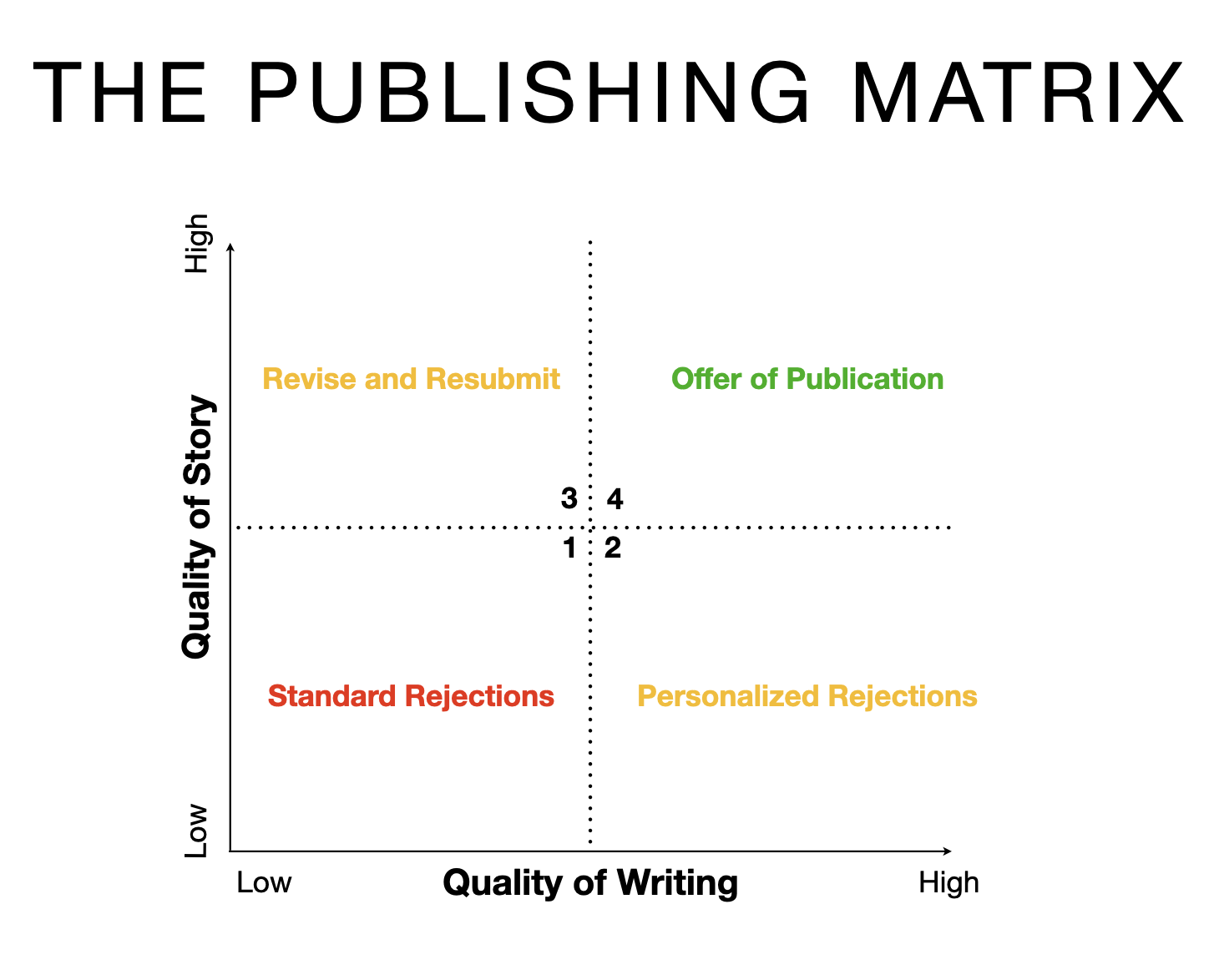


On one end of the spectrum, you have a high quality of writing. Great metaphors, strong nouns and verbs, the ability to spin a phrase, a sentence, or a paragraph and get people to sigh (or laugh, shriek, or cry) in delight. But they can’t tell a coherent story to save their lives. The plot is all over the place and it’s hard for readers to tell what’s going on or where they even are in the story. What happens is that if you have a high quality of writing and low quality of story, you may start getting Personalized Rejections. You might get feedback on how you could improve. 


On the other end of the spectrum, you have a high quality of storytelling, with amazing plot points, tension, high stakes, etc, but the quality of writing isn’t all that special. If the editor falls in love with the story, so long as the quality of writing isn’t too terrible, this can result in a Revise and Resubmit. It’s a little better than a Personalized Rejection, but it’s still not a book contract. And so that’s the second one.


And the third one is if you have a boring story that doesn’t work combined with poor writing, then that results in a lot of Standard Rejections. You likely haven’t either practiced much or studied very much. This is where most writers begin: with Standard Rejections. 


You can write beautiful words all day long, but if you’re not telling a great story, then nobody cares about your writing.


Remember, good storytelling is more important than good writing, but you have to have BOTH to get published.


The Four Fundamentals of Story

The four fundamentals of story are character, conflict, plot, and theme. Everything else (setting, dialogue, tense, genre, point-of-view) is secondary.
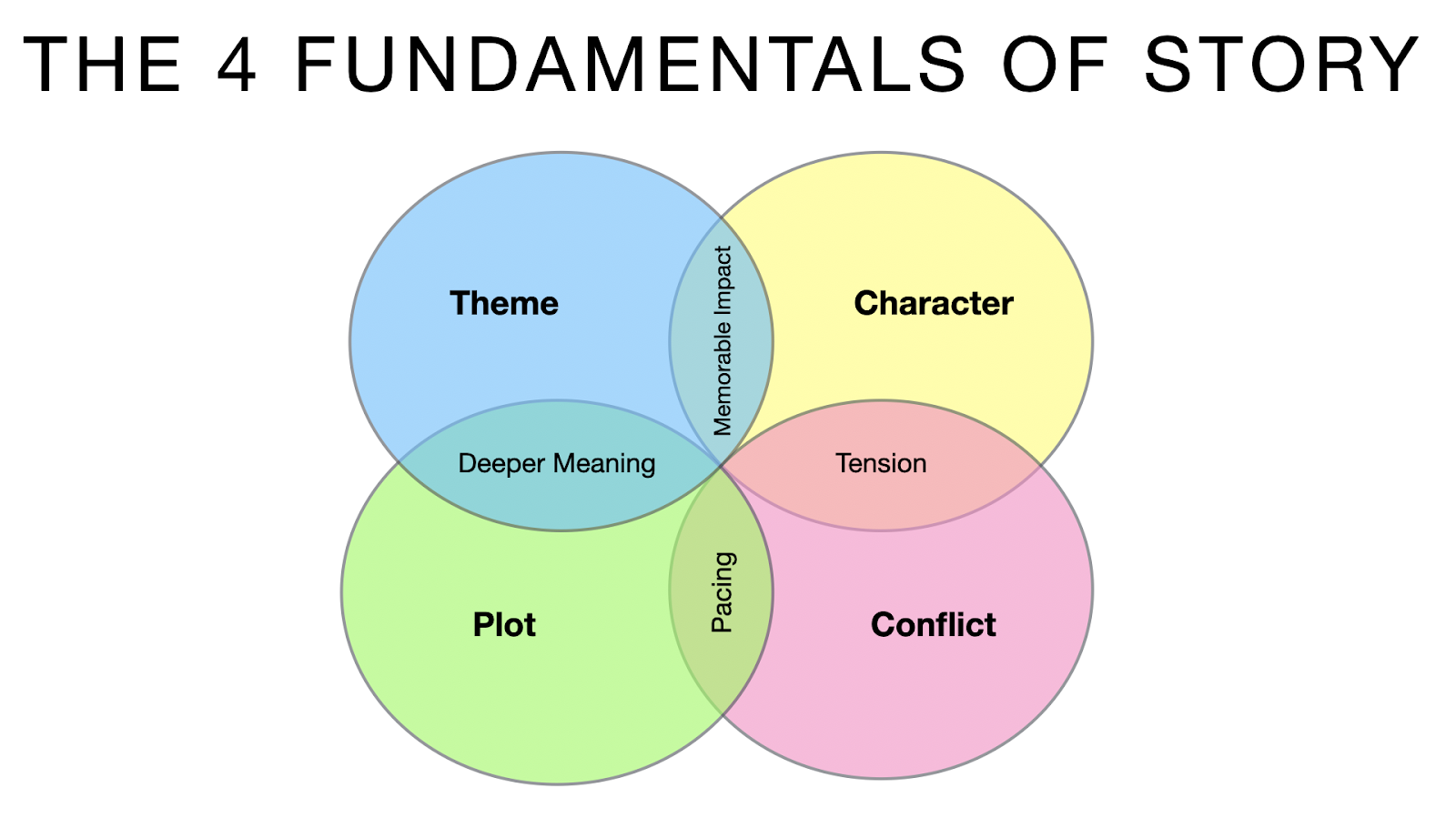
When you have an interesting character experiencing conflict, you create tension. When you have conflict and plot, you create pacing. When you combine theme with plot, your story embodies a deeper meaning. And when you combine character and theme, you create a memorable impact in your reader’s life.


These elements combined together create STORY. And this is the structure that most writers fail to analyze because when rejections come, it’s usually due to one of these four elements.

>> FREE PLOT ROADMAP AND BOOKMARK <<

Big Idea #4: Revision Starts with Plot

The Importance of Revision

The first few revisions of your manuscript are for fixing plot holes. Revision does not mean editing sentences. That’s called editing.


I know how tempting it is to start with editing. I used to tackle my “revisions” by starting out with editing sentences. When I finally got it “perfect” after who knows how many “revisions”, I finally saw the actual plot holes, and sometimes had to start all over from scratch. But there’s a better way.


When you understand this framework, you’ll be able to put plot first in your writing. You’ll be excited to tackle revisions (and your plot). Revision actually starts with plot.


Whether you plot before your rough draft or after, you still need a plot. Technically, you could start “revising” before you even start writing (if you use a plot outline). Either way, you’re still going to need to revisit your plot. 


>> The 5-Step Method for a Publishable Novel <<

Three Quotes About Revision

These three writing quotes from famous authors sum up the importance of revision beautifully. Robert Graves says, “There is no such thing as good writing, only good rewriting.” Justice Louis Brandeis says, “There is no great writing, only great rewriting.” And my favorite one is by James A. Michener, who says, “I’m not a very good writer, but I’m an excellent rewriter.” Revision is re-seeing and re-writing.


Revision Breakthroughs

After five years of taking my writing seriously, I had revised a handful of my picture book manuscripts enough times (10-20 times each) that my critique partners and I agreed they were finally submission-ready. I started submitting to publishers. And then, I had several breakthroughs: 


  • I was offered a contract for 1 of my mss

  • Another ms made it to acquisitions

  • Another ms won 1st place in a regional contest

  • And I signed with an agent! 


None of that would have been possible without revisions. 

The Five Stages of Revision

I don’t know if you consider yourself a plotter or a pantser, but either way - revision starts with plot. Let me explain.
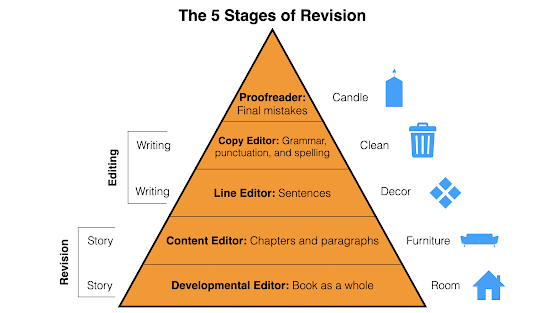
Think about a house. Your book is like a house, or more specifically like a room in a house. Each chapter of your novel is like the furniture in that room. Once the furniture is placed where you want it, then you start adding decor, or in the case of writing a book, editing sentences. After that, you clean, dust, vacuum, polish, etc. With your novel, that’s when grammar, punctuation, and spelling finally come in, not first. And finally, you can put the final touches on the room, like lighting a scented candle for ambiance. In your book, that’s where a proofreader comes into play, to catch any final mistakes that the copy editor missed.


The five types of editors a novel needs to go through, in this order, are the following:

  1. Developmental Editor - They look at your book as a whole, they look for plot holes in your story.

  2. Content Editor - Again, we’re at the base level of revision. This type of editor looks at chapters, scenes, and paragraphs.

  3. Line Editor - This is where an editor will look at your sentences, the flow, the syntax, what can be cut or said better. A lot of beginner writers tend to start here, including myself.

  4. Copy Editor - The copy editor looks at grammar, punctuation, and spelling.

  5. Proofreader - This is when an editor checks over the final print proof before publishing to catch any final mistakes the copy editor missed.


Revision starts with plot, with the book as a whole. The focus is to fix the story. Remember that story is more important than writing. The first two layers focus on revising the plot. The second two layers of the writing revision pyramid focus on editing the writing.

Writing Statistics

According to a survey of nearly 200 writers, the #2 challenge most writers face is not knowing how to revise - or working through the revision process. In addition...


  • 80% of novels are rejected because of poor structure

  • 90% of writers fail at the premise

  • 90% of novels are rejected on the first page

  • 98% of novels are rejected by the end of the first chapter


Plot is the foundation of a strong story and revising your novel begins with looking at the plot.

>> FREE PLOT ROADMAP AND BOOKMARK <<

Big Idea #5: Plotting Equals Freedom

The Importance of Plotting

Plot is what keeps people turning the pages and saying things like, “I couldn’t put the book down.” or “I had to find out what happened next.” Plot is the element that keeps people binge-watching TV episodes on Netflix. Remember, without a strong plot, you’ll have a weak story. And without a strong story, you’ll probably never get that book contract.

A lot of people think that plot outlines are restrictive, but that’s not true.

A lot of people think that plot outlines are restrictive, but that’s not true at all. When you have the five main plot points, they act as mile markers for you and it can actually give you more freedom to express yourself creatively. Plotting ahead of time equals freedom and extra creativity in your writing.

The Five Main Plot Points

Think about the stages of running a race, especially a marathon. This is what it looks like.


  1. The Signup - You get registered for the race.

  2. The Gunshot - You cross the starting line.

  3. The Halfway Point - You make it to the midpoint of the race and feel like you can keep going.

  4. The Wall - You hit the metaphorical “wall” and feel like you can’t keep going any further.

  5. The Finish Line - You finally reach your goal of crossing the finish line.


Let’s take a look at how you can apply these five main plot points to your novel’s storyline. I’m using the movie, Wonder Woman, as an example.



  1. The Signup - Steve Trevor, a spy soldier, crashes his plane into the Amazon island’s invisible forcefield.

  2. The Gunshot - Diana, aka Wonder Woman, leaves her island home and joins forces with Steve to help end the war.

  3. The Halfway Point - Diana leads the troops through No Man’s Land and she and Steve share a kiss.

  4. The Wall - Diana watches as Steve sacrifices his life for the greater good.

  5. The Finish Line - Diana defeats Ares and ends the war.


While this may seem like a simplistic overview of the movie’s storyline, each of these main plot points is strategically placed to make the story’s character arc have growth and provide a satisfying ending about what happens in the story.


When writing your own novel, it’s a lot harder than it looks to get these five main plot points right. But when you do, you’ll have a much greater understanding of where your story is headed and how to get there.

>> The 5-Step Method for a Publishable Novel <<


Let’s review the big ideas we’ve covered today.

  1. You are a writer. 

  2. You can do hard and scary things.

  3. Story is more important than writing.

  4. Revision starts with plot.

  5. Plotting equals freedom. 


If you’d like to gain a deeper understanding of how to plot a novel, free masterclass, The 5-Step Method for a Publishable Novel


What’s been the most valuable from this Ultimate Guide to Plot Your Novel? Let me know in the comments!


AddToAny

Link Within

Related Posts Plugin for WordPress, Blogger...