Monday, October 22, 2012

Lucky Clover Picture Book Contest: SUMMER Winner Announced!

The Lucky Clover Picture Book Contest announces winners four times a year. The SUMMER contest ran July through September and now it's time to announce the latest winner. A big congratulations goes out to...

Lauri Meyers

for her manuscript:

Don't Splash the Mama 

It's a cute little story for 0-2 year-olds about bath time fun and imagination. 

Lauri, you can expect your critique in your inbox within 2 weeks. Everyone please take a moment to congratulate Lauri or even visit her at her blog.

Note: Submissions are now open for the FALL 2012 contest. Be sure to send in your entries by December 31.

Friday, October 19, 2012

[3 of 3] How to Choose a Web Designer

So you're a published author. You've decided to take the plunge to ratcheting up your career. Whether you need a website designed from scratch or you already have one and want it completely revamped, you have decided to go with a professional web developer to design and manage your site. But how do you find one? Here are some ideas...

How to Choose a Web Designer || author websites | should writers create their own website | marketing for authors
  1. Look at the sites of the authors you love and find out who designed their sites.
  2. Get referrals from friends who have paid someone to do theirs.
  3. Google "web design for authors" and you'll get about 10 hits on the first page.
  4. Check out the listings in the SCBWI catalogues or other organizations of which you're a member.
With hundreds of web design companies, and at least a couple dozen that specialize in web design for authors, how in the world do you choose?


9 Essential Things for a Great Author Website


DOWNLOAD FREE BLUEPRINT


Price is not the most important thing. I know it matters to your bank account, but again, I repeat, price is NOT the most important thing. So what is? STYLE and FUNCTIONALITY!
  1. Visit ALL of the sites you found. Look at their portfolios. Get a feel for the company by examining their site. 
    1. Do you like the style of the sites they've made? Did you visit several of the sites? Are they easy to navigate?
    2. Can you envision working with this company? Is their site easy to navigate? 
    3. Does their FAQ page answer most of your questions? (Do they even have an FAQ page?)
  2. Narrow your list down to your 3-5 favorites.
  3. Think about how you want to operate in the future.
    1. Do you want to be able to make your own edits? (Are you semi- tech savvy?)
      1. Ask if this is an option.
    2. Do you want to pay one company for site updates (if that's what you want) and hosting services, or do you want to pay "A" for hosting and "B" for updates.
      1. Ask if they offer web hosting too.
    3. Do you want to work with a small company or a large company?
    4. Write down any other pertinent questions you may have.
  4. Make up a pros/cons list for your 3-5 favorites based on feel, style, and professionalism. Try to put them in order from most favorite to least favorite. See if they give a guesstimate for how much they charge. Some sites will say, and some won't, but don't let that be the determining factor. 
  5. Get a quote! Get a feel for the person you'll be working with. 
    1. Do you feel like they'll understand what you want?
    2. Do you feel like you'll be able to work with this person for a long time?
    3. Ask how long they think it will take?
    4. Choose the ONE you feel best about and just run with it. If in doubt, PRAY.
Lastly, get out your wallet and enjoy the ride!


9 Essential Things for a Great Author Website


DOWNLOAD FREE BLUEPRINT


Read the other posts in this 3-part series:

#1: What Makes a Good Author Website?
#2: The Cost of Having a Website
#3: How to Choose a Web Designer

Keep on keepin' on...

Wednesday, October 17, 2012

[2 of 3] The Cost of Having a Website

There are four basic costs involved in having a website. Before jumping in, you should be aware of what those costs are. (Next post: how to decide on a web designer.)
  1. Domain names
  2. Hosting service
  3. Site creation
  4. Updates
The Cost of Having a Website || basic costs of owning a website | author website tips | cost of domain name | hosting for author websites | domain names for writers

DOMAIN NAME: The first and simplest cost is that of registering your domain name.

Prices range from $4 a year to $15 a year, with the average being $8-12. 

Beware of going with the cheapest because they'll offer lots of add-ons (for extra money) that may be included in a plan that charges more.

You can sign up for your domain name without even hosting a site. That lets you snag your name before someone else does. With writers, you should decide what your pen name will be. If your name is Jane Doe and you want all your books to say "by Jane Doe," then you'll probably want your domain name to be www.janedoe.com, but if it's taken, you could consider using your middle name, middle initial, or maiden name in your byline instead, especially if you don't have a book published yet. Jane Rita Doe, Jane R. Doe, Jane Whitmire Doe. If you don't want to do that because you already have books published, you could possibly use www.janedoebooks.com or janedoeauthor or janedoewriter. The point is that you don't want someone else to "steal" your domain name. A couple of good ones are godaddy.com and 1and1.com.


9 Essential Things for a Great Author Website


HOST SERVERS: Another necessary expense for website upkeep. After your site is created, the domain and all it's attached pages will need to have a place to live online. That's called a server, or web hosting. Without it, your site could not be live.

Prices range from $5 a month to $20 a month, with the average being $10-15, for an annual expense of $120 to $180. 

A few of the top web hosting services are hostgator.com, godaddy.com, 1and1.com, fatcow.com, and dreamhost.com. If you make your own website, you can probably host it there as well (Wordpress, Wix, Godaddy, Weebly, etc.).

If you hire a professional, you may have a couple of options: to continue (or begin) to host on your own, or let your web designer host it for you (for a fee - usually $10-15 a month). This could be a benefit if you pay your designer for updates, then you only have to pay one entity instead of two separate ones.

SITE CREATION: This is by far the most expensive cost of getting a website, but it's a one-time payment, unless you hire someone a second time to get a completely revamped web design later on.

Fees typically range from $700 to $7,000, with the average being around $2,500. 

The range is widely varied because of individual needs, the number of pages, the skill of the designer, how customized the site will be, etc. I highly advise this option as it will be a much cleaner and professional site.


9 Essential Things for a Great Author Website


UPDATES: If you create your own site, then this will be FREE. If you (wisely) go with a professional, there could be a couple of options. Some designers create your site using certain tools that will allow you to update your own text, photos, etc. Be sure to ask. If you don't feel like fooling with that, most designers charge around $25 an hour for updates. 

But really, how often does an author need to make updates? And how long will it take? Maybe 2-3 hours per year, if that. It totally depends on how fast you publish books and how many changes you want to make. This is really not that large of an expense, when you think about it.

In the end, is it worth the expense? If you consider yourself a professional writer, then having a professional website is like handing out free business cards to every one who has read your book and having them hand out cards to everyone else they know that they think will like your book too! It's just plain old good business sense. Just remember what makes a good website, and that it's totally okay to make your own before you're published. Happy writing!

Read the other posts in this 3-part series:

#1: What Makes a Good Author Website?
#2: The Cost of Having a Website
#3: How to Choose a Web Designer

Keep on keepin' on...

Thursday, October 11, 2012

[1 of 3] What Makes a Good Author Website?

I've been thinking a lot lately about the qualities of a good author website. As a writer, I am constantly looking at books, researching those same books online, looking up authors, searching out debut authors, connecting with bloggers, surfing in online bookstores, checking out agents and their sites, researching editors and publishers. I've gotten pretty good at identifying what I like and don't like and what works and what looks unprofessional.

What makes a good author website? || how to design a website | should writers make their own websites | qualities of a good author website

It's the same with reading books. The more you read, the more you know what you like and don't like. I'm a picture book person and quite choosy about which books I label as my favorites. There are a lot of picture books I absolutely adore. And then there are a good number about which I am left asking, "And this got published because why?" or "Cute, but who's going to buy it?" The more you look at other authors' websites, the more you'll have an idea of what you like and don't like and how you might want to go about designing your own.


The point is that when you get yourself a website, it needs to be good. If you are a writer who is more or less just starting out (i.e. "pre-published"), then you could make your own website for kicks and for practice (like I did), but don't keep it once you're published. When you cross that bridge, it's time to upgrade, revamp, or go all out and get a professional site.


Most Important Elements of a Professional Author Website


The sweet spot for the number of navigation tabs (listed in the "Informative" bullet) is 5 to 7, but you can get creative and group some in a drop-down menu.

Beautiful


Visually appealing. Professional-looking images. Not choppy, too small, or too big.

Voice


It's gotta BE YOU! This can by a style, a theme, or even just the color scheme.

Informative


The best sites have most (but not all) of these tabs:

  • Home 
  • About
  • Books
  • Blog (if you have one)
  • Contact
  • News
  • School Visits (if you do them)
  • Resources (for writers, parents, teachers, educators, or kids)
  • Activity pages or Fun & Games (if applicable)
  • Calendar (for upcoming events)

Efficient


The information presented should be easily accessible, look sleek, and run smoothly. Navigating from page to page should be seamless, enjoyable, and not take any extra brain power.


9 Essential Things for a Great Author Website


DOWNLOAD FREE BLUEPRINT


Good Examples of Picture Book Author Websites

Elements of a Sub-par "Homemade" Author Website


  • no header or banner
  • no prominent display of author's name (adding a GOOD author photo is also a good idea)
  • no images (or using only clip-art style images
  • everything in sharp squares (old-style html)
  • images and/or text doesn't line up
  • strange lines running where there shouldn't be any
  • large text
  • too much bold text
  • every page is a different color
  • book page with
    • no current books (if you're published)
    • no links to buy books (IndieBound, Amazon, Barnes & Noble)
    • no book cover images
    • no ISBN numbers, publisher, date, or summary of book
  • no contact info or link
  • difficult navigation (tabs not displayed on every page)
  • tabs only at the bottom of the site (instead of at the top or to either side)
  • every page is a giant image (including the text), like a PDF
  • no links
  • using animated images
  • long text/lists with no images
  • links that say CLICK HERE
  • too many fonts and colors for text on the same page
  • INCONSISTENT from page to page 
  • inconsistencies within a single page 
  • distracting and/or busy backgrounds
  • a site that is actually a blog (okay for beginners, but can be tricky when adding more depth or more pages, although Wordpress is a good option)


9 Essential Things for a Great Author Website


DOWNLOAD FREE BLUEPRINT


What are some of YOUR favorite author websites? Share in the comments!

Read the other blog posts in this 3-part series: 
#2: THE COST OF HAVING A WEBSITE
#3: HOW TO CHOOSE A WEB DESIGNER

Keep on keepin' on...

BACK TO TOP | READ MORE POSTS

Thursday, October 4, 2012

HIGH FIVE #21: Nothing Like a Puffin

It's time for another HIGH FIVE interview to spotlight a debut picture book author. Today, please welcome Sue Soltis, author of Nothing Like a Puffin. With two active boys, Sue is well qualified to discuss Halloween, superheroes, and patience. Take it away, Sue! And by the way, her boys are nothing like a puffin...


Here’s a big HIGH FIVE congratulations to you for your debut picture book.
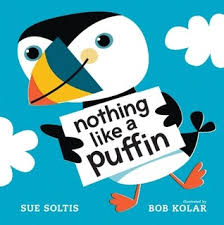
Title: Nothing Like a Puffin
Author: Sue Soltis
Illustrator: Bob Kolar
Publisher: Candlewick Press
Release date: September 2011
Word count: 460
Short summary:
A puffin is an amazing creature. It's completely unique and one-of-a-kind. A ladder is nothing like a puffin. A house is nothing like a puffin. A newspaper is nothing like a puffin... But wait! Who would have guessed? Could these things be more alike than you think? Young children will love following this mischievous puffin in an entertaining exercise in creative classification - and are guaranteed to start looking at everyday things in a whole new way.

Question ONE: What are three of your favorite picture books? Just three mind you.

  1. One Witch by Laura Leuck, illustrated by S.D. Schindler (since Halloween is coming!)
  2. What the Ladybug Heard by Julia Donaldson, illustrated by Lydia Monks
  3. Monster Sleepover! (kind of Halloween-ish too) by Scott Beck
I have heard of What the Ladybug Heard before; it sounds quite intriguing. (Is Halloween your favorite holiday?)

Question TWO: What is your bedtime routine like with them? How do books play a part in that?

I have two boys, 9 and 4. They have introduced me to the fine details of worlds I only dabbled in before—like superheroes, Star Wars and dinosaurs. We read to our younger son every night and are always carting books back and forth from the library—mostly because it’s an unusual book that wants to be read again and again. We don’t always agree on favorites, but a lot of times we do. Right now, we’re on an Oliver Jeffers kick, everybody loves his books, even my 9-year-old—who mostly reads on his own every night. Somehow he’s claimed the best seat in the house, but what a pleasure for me to be able to just sit down, even in the second most comfortable place and read. Of course, books are the best part of bedtime and the one lure that makes it even possible. Books are always at the tail end and usually earlier too!

I agree; books are the best part about bedtime. My 8-year-old son still does not read much to himself, aside from Pokemon books. I hope he will eventually catch on to the fire of reading. I wonder what book will make the change for him.

Question THREE: How might teachers use your book in the classroom?

I think teachers like it because it’s a fun take on a compare and contrast lesson. Kids can come up with their own comparisons to puffins—things that are really unlike puffins or that have a lot of similarities. Also, I think it’s a great book to read out loud to a class. It’s the kind of book that kids will have something to say about in the middle; its’ not so much a very quiet bedtime book. For older kids, teachers could use it to teach Venn diagrams. And, all of this logical thinking is a basis for math too!

Yes! Venn Diagrams, for sure! Imagine that…literature and math combined. You’ve written a cross-curricular book! We should share it with every teacher we know.

Question FOUR: Can you tell us a little bit about your revision process and the illustrator’s role in your book?

My first draft did not have illustrator notes, but somewhere along the way there was one revision that did. That was totally discarded. I’ve come to the conclusion that illustrator notes should be avoided, and most editors and publishers will tell you that. But, actually, I’d take it further than that—I avoid writing stories that would even need illustrator notes. Sometimes, when I review my work I take out things that can be shown—but it can be a delicate balance as to what to leave in, what to take out (as usual!). Because of a piece I’m working on that is more character-centered, I’ve been thinking about this a lot.

A good illustrator really does have the ability to visually create a story. I was amazed by Bob Kolar’s illustrations; I think he really captured the tone of the text and he created a page-to-page swing. On the flipside, in the final edits of Nothing Like a Puffin, a line or two of text was taken out because the illustration covered it. So those lines served as illustrator’s notes, in the end, although they weren’t conceived that way.

My title never changed. In fact, it was the springboard for the story. But otherwise, there were so many revisions! I did not keep count, and to tell you the truth, I’m still reluctant to go back and check. But there were pre-contract revisions, post-contract revisions, final revisions, re-wordings for a UK version, and revisions once the illustrator was on board.

Bob Kolar is awesome! It’s a good thing writers are flexible and they we enjoy revisions (okay, maybe some of us do).

Question FIVE: What are your top three writing tips you can offer to writers seeking publication?

  1. There’s a question, because I don’t feel like I’m there yet. I’m still ready for people to give tips to me. However, patience must be number one because it’s the rare writer that doesn’t get snagged somewhere: looking for an agent, shifts in editors at publishing houses, getting the next book contract, deciding to throw away that last story and start with something new.
  2. Second is the craft; it’s startling how you can always make it better. So while you’re waiting, work on the next thing, and make it better. Make it better again. Is that three?
  3. One more—recently I started a critique group after running out of excuses. I had many: I’ve been in so many workshops I think I’ve internalized the process, I don’t think I can find people, and I don’t have time! But I’m finding it’s a great motivator for writing, wonderful for combating that reality of working in isolation and a pleasure to see people’s work in progress.
Thanks so much for being with us today, Sue! It was delightful. Hope to see your second book, soon!

Sunday, September 30, 2012

SCBWI - Carolinas: Things I Learned

What a rush! Friends, books, editors, agents, AUTHORS, and food! These are just a few of the highlights I took in from the sessions I attended at the 2012 SCBWI Conference (Society of Children's Book Writers and Illustrators). If you can glean one or two bits of wisdom from these notes, then I'm glad I could share. Enjoy!

Writing Tips from Authors, Agents, and Editors || advice for writers | writing conferences | highlights from SCBWI | writing career

Things I Learned or Re-learned

"Launch My Career" by author Alan Gratz

  • Say "I think the audience of such and such a book will enjoy my book." Not "My book is the next such and such book.
  • Find editors and agents in the SCBWI "Edited By" section with the Market Survey and Agents Directory.
  • Advances are usually paid half at signing and half on acceptance of final draft for novels.
  • Say "That is an awesome offer! Thank you so much. May I have a few days to think about it?" Then get an AGENT!
"Agent Panel" by Jennifer Rofe, Liza Voges, and Sarah LaPolla
  • It's all about the writing.
  • Ask yourself why you're writing what you're writing.
  • Know who your reader is.
  • Look at the Core Curriculum.
  • Summer is a bad time to query agents because of all the teacher/writers being off during the summer.
  • Agents get way more rejections than writers do!
"Keynote Address" by SCBWI President and author of 60+ books, Stephen Mooser
  • Digital going strong, but books are here to stay.
  • Make consumers aware of what good literature is.
  • Ask how your book could fit into technology.
  • Story must be terrific and unique.
  • Be persistent.
  • Giving weather reports are good practice for mood and setting.
  • Give your characters a grand entrance.
  • Follow your weirdness.
  • Don't rush it.
"Am I Wasting My Time if I Rhyme?" by author Kristy Dempsey
  • No!
  • Beware of unnatural phrasing, forced rhyme, near rhyme, inverted word order, and meter that's off.
  • Consider natural accents by using the word in as many sentences as you can think of to test the word in question.
  • Have fun!
"The Shape of Things to Come" by editor Daniel Nayeri
  • A few big publishing houses now have three separate divisions: hard back division, paper back division, AND now a separate digital division. 
  • Embrace the digital world.
  • Marketing team will market your book.
  • A publicist will publicize YOU.
  • Electronic Rights vs. ENHANCED Electronic Rights
  • Simple enhancements that let the book remain a book:
    • searchable text
    • wiki definitions
    • hyperlinked index
    • embedded media
    • light animation
  • "All art aspires to the immediacy of music." --???
  • The BEST app ever is The Elements.
"Character, Humor, and Series in a Chapter Book" by author and SCBWI President Stephen Mooser
  • First book in a series the hardest to write because you're trying to get to know your characters.
  • End chapters with a cliffhanger.
  • The subplot needs to help solve the main plot.
  • Have 3-4 main characters who can work together.
  • Ways to add humor:
    • incongruity (a cheerleader in a mudpit)
    • reversal of roles (a nerd in the easy class)
    • understatement
    • gentle foibles (weaknesses get them into troublesome situations)
  • If you stare at 5 words long enough, you'll think of a story.
"Author's Round Table" with various authors
  • Don't spend your time blogging or building a website when you should be writing.
  • Your blog can stand in as a simple website.
  • Craft comes first. 
  • Be persistent!
"The So What Factor" by agent Jennifer Rofe
  • Why does it matter?
  • Why should the reader care?
  • Emotional impact - create characters that readers can care about.
  • Compelling plot - put your characters in a tree and throw rocks at them, then help them down.
  • Connectivity - everything that happens must happen for a very specific reason.
  • Your characters must grow and change as they go through obstacles.
  • They must make difficult decisions.
  • Mostly applies to novels, but can still apply on a much smaller scale to picture books.
"Farewell Keynote - We Are All Apprentices" by editor, Molly O'Neill
  • We are in careers that we never stop learning.
  • "Every book is its own mystery."
  • "I think we learn best from the books we love best."
  • Study the books from the gaps in our lives, from the time we quit reading kids books to the time we picked it up again.
  • Pursue things that fascinate you.
  • Mistakes and doubts help us learn.
  • It's important to get your story to a point that you believe in it before you seek advice.
  • Each book we write must be our own best book.
BOOKS/LITERATURE MENTIONED THROUGHOUT THE CONFERENCE:
  1. "For the Young Who Want To" poem by Margie Pearcy
  2. The McBroom stories by Sid Fleischman
  3. websites: Verla Kay, Harold Underdown, Editors and Preditors
  4. Writers Market
  5. Charlotte's Web by E. B. White
  6. Surfer Chick by Kristy Dempsey
  7. Hack the Cover by Craig Mod
  8. The Elements, an app
  9. The DaVinci Code by Dan Brown (for cliffhangers)
  10. 101 Black Cats, and Disaster in Room 101 by Stephen Mooser
  11. The Hunger Games by Suzanne Collins
  12. Twilight by Stephenie Meyer
  13. Harry Potter by J. K. Rowling
  14. The Giver by Lois Lowry (perhaps the first dystopian novel ever)
  15. Dear Genius by Ursula Nordstrom
  16. The Gates of Excellence by Katherine Paterson
  17. The Making of a Writer by Joan Lowery Nixon
  18. A Christmas Goodnight illustrated by Sarah Jane Wright
  19. Walking on Water: Reflections on Faith and Art by Madeline L'Engle
  20. But I'll Be Back Again, memoir by Cynthia Rylant
  21. A Dog's Way Home by Bobbie Pyron
BOOKS I BOUGHT:
  • Surfer Chick by Kristy Dempsey (picture book)
  • Being Frank by Donna Earnhardt (debut picture book)
  • Steering the Craft: Exercises and Discussions on Story Writing for the Lone Navigator or the Mutinous Crew by Ursula K. Le Guin
  • It was the best of sentences, it was the worst of sentences. by June Casagrande
  • The Encyclopedia of Writing and Illustrating Children's Books by McCammon, Thornton, and Williams
Keep on keepin' on...

Tuesday, September 25, 2012

Advice is Like Snow

"Advice is like snow; the softer it falls, the longer it dwells upon, and the deeper it sinks into, the mind" --Samuel Taylor Coleridge

Samuel Taylor Coleridge quote || Advice is like snow | critique groups | writing advice

I've been thinking about advice ever since my dad said he won't give it anymore. Which was months and months ago. Yesterday, I was thinking about my fabulous critique group. And now, I have another comparison for what advice is like.

Advice is also like a critique. As a writer, I welcome critiques. I expect them to be honest, thorough, helpful, and sprinkled with the goodness of praise. As a human, I don't necessarily welcome critiques (or opinions) - of character, flaws, weaknesses, problems, etc. that I may have. But advice? Advice is usually welcomed when asked for, just like a critique from your writing partners.

So...if someone asks for advice, don't hold back. Start with something positive. Give your opinion on what they specifically want. If they didn't value your opinion, they wouldn't be asking for your feedback. End with a second or third positive statement. In a critique group, we want, ask for, and expect advice in the form of a critique. If someone asks you for personal advice, then they trust your experiences and your judgment. Just like a critique, the author may or may not USE your advice, but listening to it is still helpful and effective.


Monday, September 24, 2012

Research Makes a Difference

Politics and literature. Voting or writing. Research makes a difference. If you're writing a novel set in the 1800's, you better have enough research done to back up your character's decisions. The reader needs to feel that the setting is believable. If you're writing a nonfiction picture book, your facts need to have verifiable resources. No teacher wants to inadvertently be teaching a child that a kangaroo is not a marsupial.

Just as in writing, there's a certain amount of research that should go into voting as well. If you think you know who you're going to vote for during the upcoming presidential election, I only ask one thing of you as a fellow citizen. Please do your research, at least a little. And don't rely on other people's opinions, especially the media. That's like using Wikipedia as your go-to source for writing a book about the holocaust, or any other subject for that matter. At the very least, please go directly to each of the candidate's websites.

I did. And I was surprised at what I found. I went to the one I thought I might vote for, and continued to be solid in that decision...until I checked out the other candidate's site. I was surprised at how thorough the information was presented. I was impressed! I feel like I did my research. I know who I'm voting for! Granted, the amount of research was akin to only giving two references for a 10-page research paper. But at least I'm not voting blind. I'm not a "Wikipedia voter"! Don't let the media sway you.

Please, I implore you to check out both websites! Go straight to the source, whether you're a Republican, a Democrat, or Nonpartisan, especially if you're registered as an unaffiliated voter. Pay special attention to the levels of experience, education, history, and the plans for the future. Don't vote based on 2-3 issues you feel most strongly about. Try to look at the picture as a whole. Good luck! "See you" on election day!

www.mittromney.com

www.barackobama.com

P.S. No, I'm not telling you who I'm voting for...

AddToAny

Link Within

Related Posts Plugin for WordPress, Blogger...